
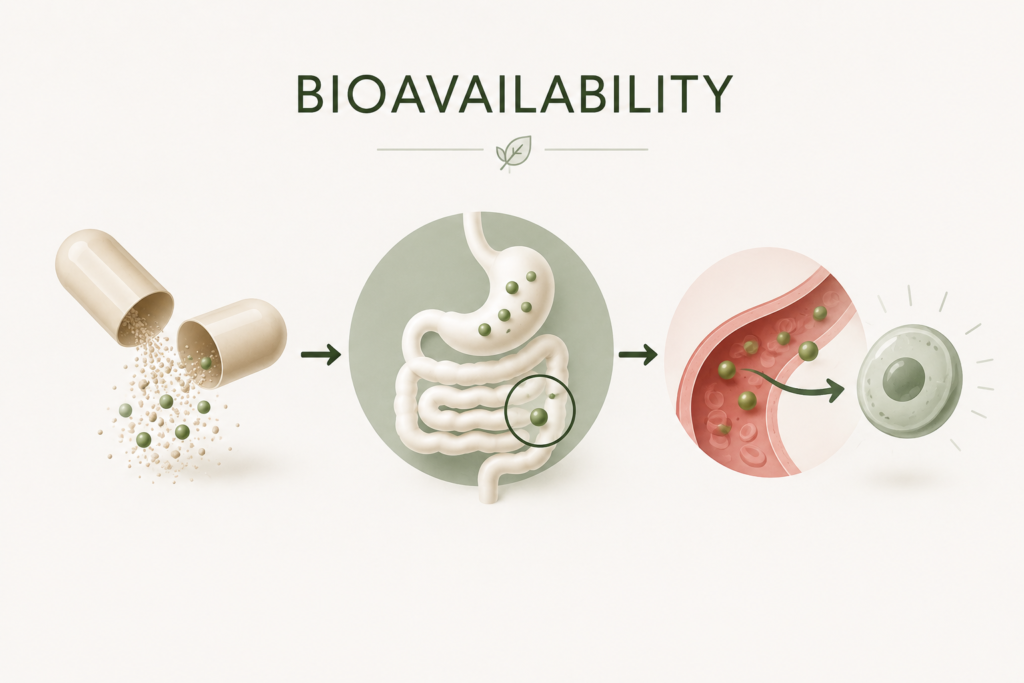
Chances are you’ve taken an expensive supplement that didn’t do anything for you. Your first reaction was likely to consider whether the ingredient itself is efficacious. But rather than ask yourself this question, which you might never find on a product label, consider whether or not the ingredient even made it there.
Supplement bioavailability refers to the percentage of an ingested compound that eventually enters the bloodstream. Not what goes into the body. Just what survives the trip.
It might surprise you just how much of the difference between what a supplement label says and what ends up in your system: somewhere around 4%-80% of the advertised dosage. This variance has a name, and it’s known as supplement bioavailability. It’s by far the most critical piece of information not featured on a supplement label.
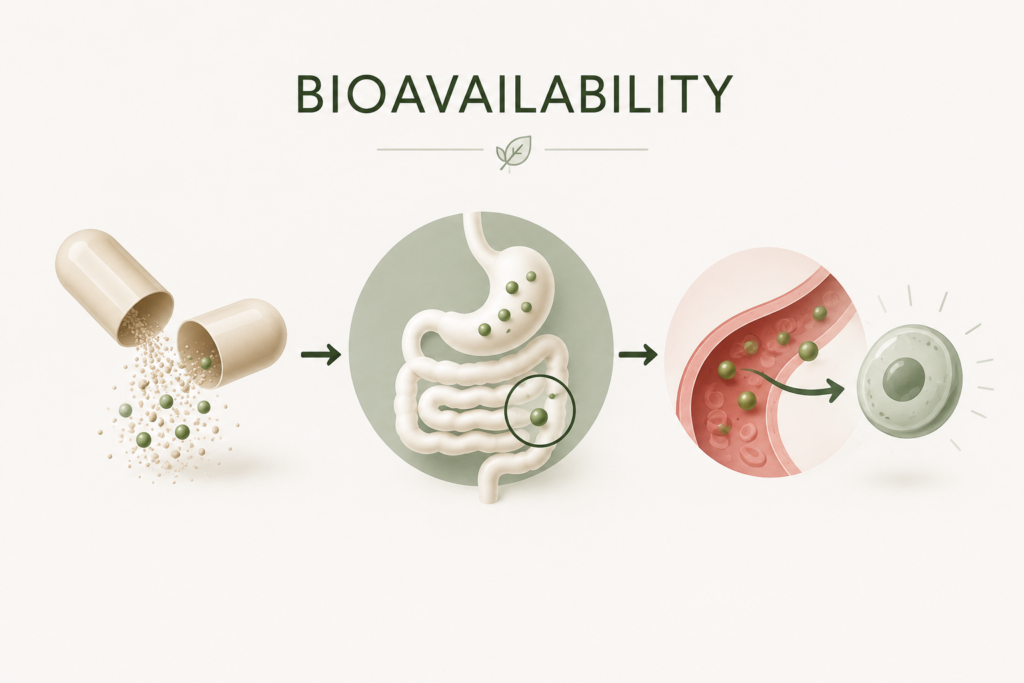
Supplement Bioavailability: How the Process Really Happens
The act of swallowing a capsule kicks off the surprisingly violent process. To make it into your system, the supplement must survive your highly acidic stomach, which has a pH between 1.5 and 3.5 and starts breaking down substances as soon as they come into contact with it. Different formulations are absorbed to varying degrees — some effectively, some largely intact.
Any compound that makes it past this stage is met by another challenge, that of crossing the intestinal wall to get into the bloodstream, a difficult task that depends on the size of the molecule, whether it dissolves in fat or water, and transporters. And finally, first-pass effect — the substance is exposed to the action of the liver, where much of it could be altered or metabolized.
This is why, when it comes to magnesium, 2 different minerals of 2 different forms in the exact same doses might produce vastly different concentrations in your blood — 80% of magnesium glycinate and 4% of magnesium oxide, respectively. Four percent. That is no small number.
4 Main Factors That Determine Supplement Bioavailability
1. The Chemical Form
Most people choose the wrong chemical form of their supplements. For instance, magnesium oxide is cheap compared to magnesium glycinate. The problem here is that you will absorb much less magnesium if you take 500 mg of a 4% bioavailable form compared to 200 mg of 80% bioavailable form. This may sound absurd but, in reality, the same mineral can provide very different results depending on its form.
2. Fat Solubility Versus Water Solubility
There are some vitamins that are fat-soluble and cannot be absorbed by the body if you do not have any fat in your diet at the time of consumption. Vitamins A, D, E, and K all belong to that category. It was discovered that vitamin D3 absorption increased by approximately 32% when the supplement was taken with fat-containing foods, as shown in the Journal of Bone and Mineral Research (Mulligan & Licata, 2010).
3. Status of Your Gut
Inflammation, insufficient levels of stomach acid (particularly common among older adults, as well as in individuals using proton pump inhibitors), and damage to the intestinal barrier tissue affect absorption. There is a massive variation in serum concentrations of a single iron supplement dose taken by a healthy person vs. an individual with mild gut inflammation. Bioavailability of a supplement is not a property of the pill but rather the outcome of its interaction with your unique physiology at a particular moment.
Acid in your stomach plays a crucial role in ionizing many minerals to enable proper absorption. Long-term intake of proton pump inhibitors (PPIs) was found to impair absorption of magnesium, calcium, and vitamin B12, according to a systematic review published by Cheungpasitporn et al. in the Journal of Community Hospital Internal Medicine Perspectives in 2019. Your personal supplement needs differ from those of other adults because of your medication use.
4. Supplement Delivery method
Supplements can take the form of capsules, tablets, powders, liposomes, sublingual preparations, and others. Liposomal vitamin C is encapsulated in fat droplets to prevent degradation during first pass effect. It is yet to be determined whether liposomal vitamin C leads to better results or simply yields higher plasma concentration levels in healthy adults.
Why the Majority of the Supplement Labeling Is Lawfully True But Practically False
For example, a supplement label stating “500 mg Magnesium” is legally true. The fact is that the product indeed includes 500 mg of a particular magnesium substance. However, what such labeling ignores is how much magnesium from 500 mg would get into the body, which again varies based on the choice of form of this element, chosen arbitrarily by manufacturers mostly because of costs.
In the same way, all the information concerning supplements does not necessarily mean that the dose of an active ingredient mentioned is also the effective one. “Clinically Studied Dose” is another term worth mentioning. All studies employ a particular substance form in a certain quantity. Therefore, in case the study involved the form of KSM-66 ashwagandha root extract standardized to 5% withanolides, 300 mg two times per day, the product in question employing 500 mg of generic root powder once per day does not have anything to do with studies.
The Inconvenient Truth
Bioavailability research for supplements is not often funded by independent researchers. Most absorption studies are conducted by industries, and this doesn’t necessarily disqualify them from validity; it simply means that unfavorable results don’t make it into publications. The formulations that underperform in head-to-head absorption studies are the formulations that get heavily marketed based on price; this means that the cheapest supplements are often the ones that have the poorest independent support for their bioavailability.
What Supplement Bioavailability Means in Practice: What to Actually Do
Properly reading a supplement label entails understanding the actual form being used in relation to its bioavailability. Not magnesium oxide but magnesium glycinate. Vitamin K2 in MK-7 form rather than MK-4 (the former has a biological half-life of around 72 hours, while the latter lasts only about 1-2 hours, which means daily use is necessary). Fat-soluble vitamins require eating with food.
If you’re over 60 or taking a PPI, this is especially important, not less so.
Decoding Health take
If you take one thing from this: the question is never just “does this ingredient work?” The question is “does this form of this ingredient, at this dose, in this delivery format, survive long enough to reach my tissues?” For most adults, switching from an oxide or carbonate mineral form to a chelated or glycinate form — without changing the dose — produces a meaningful real-world difference. Choose forms over doses. And take fat-soluble supplements with your largest meal of the day, consistently.
FAQ about Supplement Bioavailability
Does cooking impact the bioavailability of vitamins found in foods?
Yes, but differently depending on the nutrient type. Water-soluble vitamins such as B vitamins and vitamin C get leached into cooking liquids and destroyed by extended periods of heat exposure. A study published in the Journal of Food Science showed that boiling broccoli for 10 minutes resulted in the loss of up to 50% of its vitamin C content. Fat-soluble vitamins are more heat-resistant but oxidise when exposed to prolonged air and heat conditions.
Are there cases where high bioavailability might not be preferable in terms of supplements?
In some cases, but not often. Higher bioavailability leads to greater physiological effects in case of virtually any micronutrient. However, some micronutrients have specific features when being absorbed because their absorption entails additional regulatory processes (e.g., the downregulation of iron absorption when reserves are sufficient). Forcing the process of absorption through certain technologies may thus cause the loss of these regulatory functions of the human body. In general, however, low bioavailability of the supplement is only a waste of money on a product that is not going to produce any effects whatsoever.
Can I improve my supplement bioavailability without any changes in the product itself?
In certain cases, it is possible. Taking vitamins D3, K2, E, and A alongside a meal rich in fats helps increase their absorption. Taking your iron supplements with a tiny portion of vitamin C helps enhance the iron absorption by converting non-haem iron into the absorbable form. The timing of your supplementation is essential as well – taking iron and calcium together is inefficient since both of these micronutrients compete for the same transporters and decrease their absorption by almost 30%.
Why do some supplements say “proprietary blend” instead of the actual forms?
This is because there is no obligation for them to reveal which chemical form it is, only the weight. Using the term “proprietary blend” is a way for a manufacturer to keep their formulation secret from competitors. As a side note, using “proprietary blend” makes it impossible for consumers to know if they are receiving the bioavailable form. This is important when the supplement says “Magnesium (as proprietary blend)” instead of “Magnesium (as glycinate).”
References
- Mulligan GB, Licata A. Taking vitamin D with the largest meal improves absorption and results in higher serum levels of 25-hydroxyvitamin D. Journal of Bone and Mineral Research. 2010;25(4):928–930.
- Cheungpasitporn W, et al. Proton pump inhibitors linked to hypomagnesemia: a systematic review and meta-analysis of observational studies. Journal of Community Hospital Internal Medicine Perspectives. 2015;5(4):27583.
- Coudray C, et al. Study of magnesium bioavailability from ten organic and inorganic Mg salts in Mg-depleted rats using a stable isotope approach. Magnesium Research. 2005;18(4):215–223.
- Maggini S, Wenzlaff S, Hornig D. Essential role of vitamin C and zinc in child immunity and health. Journal of International Medical Research. 2010;38(2):386–414.
- Hallberg L, Brune M, Rossander L. Effect of ascorbic acid on iron absorption from different types of meals. Human Nutrition: Applied Nutrition. 1986;40(2):97–113.
- Lynch SR, Cook JD. Interaction of vitamin C and iron. Annals of the New York Academy of Sciences. 1980;355:32–44.
- Schurgers LJ, et al. Vitamin K–containing dietary supplements: comparison of synthetic vitamin K1 and natto-derived menaquinone-7. Blood. 2007;109(8):3279–3283.
This article is for informational and educational purposes only. It does not constitute medical advice and should not be used as a substitute for professional medical guidance. If you are managing a health condition, taking prescription medications, or considering significant changes to your supplement regimen, consult a qualified healthcare professional before making changes. Decoding Health does not endorse specific supplement brands or products.