
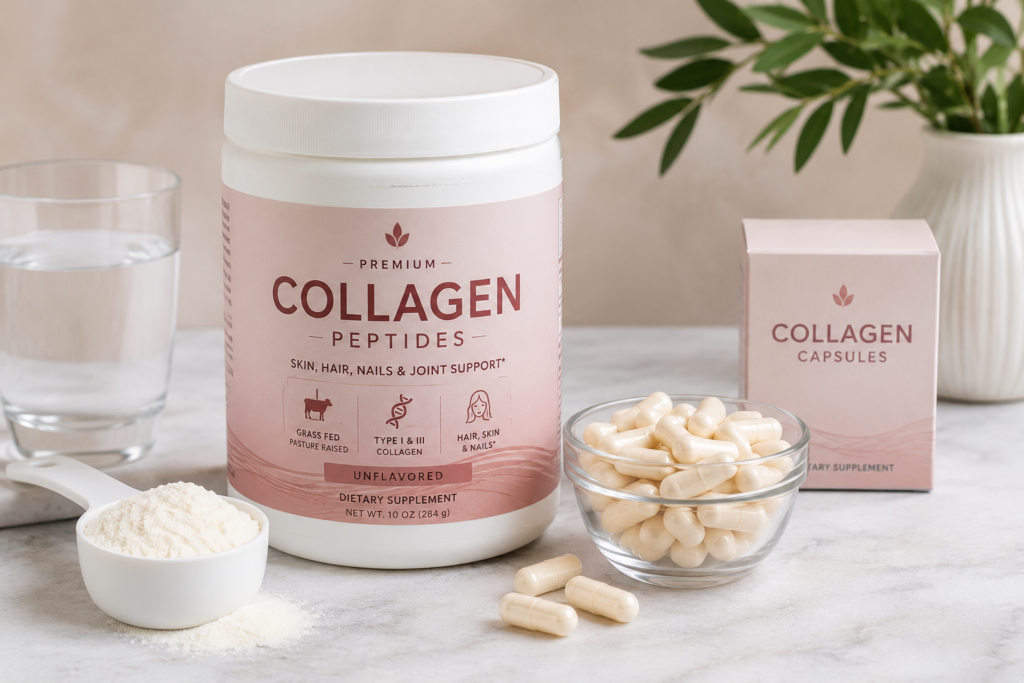
Collagen supplements for skin are everywhere right now — powders in coffee, capsules on pharmacy shelves, and gummies promising firmer, younger-looking skin within weeks. Before we all rush out to buy these types of supplements there is an important question we must ask ourselves: Is there any evidence to back up the claims made by these companies?
This article will review the published randomized controlled trial (RCT) data on oral collagen supplements for skin health (elasticity, hydration, wrinkle depth, and dermal collagen density) and not just the claims made by the manufacturer. We will be looking at all available data including systematic reviews, and mechanistic studies done on the benefits of collagen supplementation for skin.
Article Contents:
- Mechanism of Action,
- Key findings from RCTs,
- Limitations of current data,
- Suggested forms of supplementation,
- Dosages for those people who will continue to take collagen supplements
First, what is collagen, and how does its concentration reduce with age?
Collagen is the most abundant type of protein in the body of humans. The skin contains collagen, mainly in the dermis, the deep layer below the epidermis. It provides tensile strength, stability, and resilience to the skin. Types I and III are the two predominant types of collagen present in the skin.1
Starting from about the age of 25 years, there is a gradual reduction in the body’s internal production of collagen, which drops by 1% each year. When the person attains their forties, there will be a noticeable drop in the density of collagen fibers in the dermis layer, skin thickness, and skin elasticity. There are external causes that contribute to collagen degradation, including exposure to UV rays, cigarette smoking, and air pollutants, as they induce matrix metalloproteinases (enzymes responsible for degrading extracellular matrices).
This leads to the clinical manifestations of skin aging that are easily observable.2-4
How does oral collagen work?
This is where the science becomes truly fascinating and the initial doubts were not entirely unfounded!
Initially, everyone assumed that oral collagen supplementation would have no benefit because proteins (when consumed) are chemically broken down into individual amino acids and dipeptides in the digestive system, then absorbed. So how on earth would eating collagen peptides allow those peptides to travel all the way to our skin intact (let alone encouraging collagen synthesis there)?
The answer lies in the more complex science of how hydrolysed collagen, which is usually the form used for oral collagen supplementation, is absorbed. Pharmacokinetics research shows that collagen-derived dipeptides and tripeptides (most notably, Pro-Hyp and Hyp-Gly) survive digestion to enter the bloodstream after oral administration at measurable concentrations.
Once they are in the bloodstream, these peptide fragments appear to act as bioactive signalling molecules that can stimulate dermal fibroblasts (the cells that make collagen), causing them to produce greater amounts of collagen and hyaluronic acid. They may also inhibit the activity of MMPs, thus inhibiting the destruction of collagen at the same time.
What is the theory behind oral collagen?
Oral collagen has come under scrutiny due to skeptics being unable to believe some of the evidence provided in support of its use; however, there is scientific reasoning supporting oral collagen’s effectiveness, as well as logic.
In addition to the scientific reasoning behind collagen peptides being able to reach the skin intact and subsequently stimulate the production of collagen, there is also evidence that suggests that oral collagen can provide some beneficial effects to the skin. The skin is very highly vascularized and contains numerous blood vessels; therefore, any nutrients delivered via the bloodstream, whether from oral collagen or from other sources, will eventually be delivered to the skin.
The majority of collagen-providing nutrients deliver primarily through the GI tract, and collagen-producing nutrients do in fact enter through the blood and deliver to skin cells; however, one important point that must not be neglected is that the skin must still produce the collagen it needs to maintain itself.
For hairline to be effective, one must have a very good knowledge of how hydrolysed collagen (the main form of collagen used in supplements) is absorbed into the body. There have been several pharmacokinetic studies conducted, some of which have appeared in the Journal of Agricultural and Food Chemistry, showing that certain collagen-derived dipeptides and tripeptides (Pro-Hyp and Hyp-Gly) can survive the digestion process and enter into the bloodstream in appreciable amounts after oral consumption.
These peptide fragments then seem to send messages to the skin cells called fibroblasts responsible for making collagen, stimulating them to synthesize both collagen and hyaluronic acid. Laboratory and animal trials show that collagen peptides also inhibit the MMP enzyme, causing a decrease in collagen breakdown at the same time.
Key mechanism Hydrolysed collagen peptides are not just supplying the body with amino acids. They act as messengers for fibroblasts, stimulating the production of collagen and hyaluronic acid.
What Clinical Trials Say About Collagen Supplements for Skin
There is a fairly large amount of randomized, placebo-controlled trial evidence on the effects of orally ingested collagen and skin health. The table below highlights five important clinical trials in the scientific literature.
| Study (Year) | Participants | Intervention | Duration | Key Outcome |
| Proksch et al. (2014) | 69 women, 35–55 yrs | 2.5 g or 5 g hydrolysed collagen daily | 8 weeks | Significant improvement in skin elasticity vs placebo |
| Asserin et al. (2015) | 106 women | 10 g collagen hydrolysate daily | 8 weeks | Increased skin hydration and collagen density (measured by confocal microscopy) |
| Kim et al. (2018) | 64 women, 40–60 yrs | 1 g low-molecular-weight collagen peptides | 12 weeks | Reduced eye wrinkle volume; improved skin moisture |
| Czajka et al. (2018) | 112 women, 45+ yrs | 2.5 g collagen + vitamins C, E, biotin | 90 days | Improved skin moisture, elasticity, and reduced roughness |
| de Miranda et al. (2021) | 50 women, 45–60 yrs | 10 g marine collagen daily | 12 weeks | Significant improvement in hydration, elasticity, wrinkle depth |
In 2019, the Journal of Drugs in Dermatology published a systematic review and meta-analysis (Choi et al.) examining the results of 11 RCTs, which collectively included 805 patients. The analysis found that oral collagen supplementation led to significant increases in skin hydration, elasticity, and lower wrinkle scores compared to placebo control groups.
In addition, a systematic review carried out in 2021 by de Miranda et al. in the International Journal of Dermatology evaluated 19 studies to arrive at a similar finding, where improvement in skin hydration and elasticity was found to be the most consistent outcome reported, although results concerning the reduction of wrinkles varied.
The Importance of Vitamin C
Collagen supplementation in some of the trials was paired with Vitamin C (ascorbic acid), and there is reason for this. The reason is that Vitamin C is an important co-factor in collagen production – more specifically, in the hydroxylation of proline and lysine in the formation of stable collagen triple-helix structures. Insufficient amounts of Vitamin C will limit the effectiveness of collagen supplementation. It is crucial information to consider when comparing collagen powder and collagen formulations.
What is Not Supported By the Evidence
It is only fair to be scientifically honest in recognizing the limitations of what the current scientific evidence suggests. Some are worthy of mention.
- Sample size and trial duration: The number of participants enrolled per trial is less than 120, and the average trial lasts eight to twelve weeks. There is no data on long-term safety or long-term efficacy beyond three months.
- Bias due to funding: Many collagen studies published to date are funded by supplement producers. This does not make the research useless, but it is important to focus on independently reproduced results.
- Variability in study endpoints: In skin-related trials, endpoints are assessed using different methods — cutometry for elasticity, imaging and subjective surveys for other parameters. Meta-analysis is difficult in such a situation, since endpoints are inconsistent.
- Origin of the product and molecular weight: Different collagen supplements are different from each other. There are marine, bovine, and porcine collagen hydrolysate preparations. Molecular weight is important because the absorption rate varies — low-molecular-weight hydrolysates up to 3,000 Da predominate in studies.
- Lack of head-to-head comparisons with retinoids: The gold-standard therapy for skin ageing is the topical use of tretinoin (retinoid). To date, no sufficiently powerful study has been conducted to compare the effects of collagen intake with topical retinoids.
Bottom line on quality of evidence: Current evidence from RCTs is encouraging and largely consistent, though not quite at the same high standard as that of a pharmaceutical drug. There’s clear evidence of small to moderate improvements in skin hydration and elasticity, but not some kind of magic anti-aging formula.
Practical recommendation: form, dosage, duration
Form
The peptide form (also known as collagen hydrolysate) is what all studies use. Note that the form differs from gelatin (partially hydrolyzed and less absorbable), as well as from regular collagen (too large to be well-absorbed). Look specifically for the peptide form.
Dosage
Commonly studied doses are in the 2.5-10 g per day range. The majority of positive effects seen in trials occurred with doses of 2.5-5 g per day when measured in terms of skin elasticity. Doses are higher when studying skin hydration. There is no clinical basis for using doses larger than 10 g/day.
Duration
Changes in collagen density and elasticity are not likely to be detected until at least 8 weeks of continuous daily use. Positive studies lasted anywhere between 8-12 weeks, on average. Anything less than 6 weeks probably won’t make much of a difference.
Source
Marine collagen is usually of type I collagen, which forms the majority of collagen in skin. Bovine collagen is of both type I and type III. Both are supported by clinical trials. Vegetarians or vegans must know that all collagen supplements currently supported by research are animal-sourced, there being no plant collagen. Plant-derived collagen boosters have different mechanisms, which remain unsubstantiated for the most part.
Frequently asked questions
Is oral collagen an alternative to topical skincare?
No. Oral collagen is systemic through the processes explained above and cannot be used as a substitute for scientific topicals like broad-spectrum sunscreen, topical retinoid or niacinamide. Each works through different biological pathways and complement each other rather than replace one another.
Are there any side effects from oral collagen?
There are no adverse events documented in the reviewed clinical trials for oral hydrolyzed collagen. Minor and infrequent adverse effects included mild GI disturbances. Marine collagen should be avoided if one suffers from seafood allergy. It would be wise to talk to one’s physician if taking anticoagulants.
Does heating break down collagen peptides in supplements?
Collagen peptides are heat stable and maintain their structural integrity after being mixed into hot drinks and cooked with food. Unlike collagen protein, which denatures under extreme heat, collagen peptides can be added to hot drinks like coffee without decreasing their effectiveness.
Do collagen supplements for skin actually reduce wrinkles?
Yes, but the effects seem to be rather minor compared to other treatments. There have been some studies that show the effects of collagen peptides taken on a regular basis for 8 to 12 weeks can help reduce the depth of wrinkles, especially when used along with moisturizers and increased skin elasticity.
Is marine collagen more effective than bovine collagen in skincare?
Both forms of collagen have been shown to be effective through scientific testing in laboratory settings. There is a slightly higher percentage of Pro-Hyp peptide sequences in marine collagen, which have been shown to stimulate fibroblast activity in vitro tests. However, there have been no adequately powered randomized controlled trials conducted.
Conclusion
The scientific support behind oral collagen supplements for skin health is stronger now than it was a decade ago, and is certainly more substantial than you’d expect from a general wellness supplement. There are multiple randomized controlled trials (RCTs), as well as two separate systematic reviews, demonstrating improvements in skin hydration, elasticity, and to a slightly lesser degree wrinkle depth following supplementation on a consistent basis for 8 to 12 weeks.
But that isn’t to say that the science is free from its caveats. Trial size is modest, there are some obvious funding conflicts present in the literature, and the outcomes used for measuring success have not been standardized across studies. It works but doesn’t produce miracles; collagen supplements are only one piece of the skin health puzzle.
Should you decide to use one, the clear scientific choice is hydrolysed collagen peptides taken daily in doses of 2.5 – 10 grams alongside a sufficient intake of Vitamin C for 8+ weeks.
Decoding Health take: While the hype surrounding collagen is definitely ahead of its scientific backing, the backing does in fact exist. This makes collagen supplements better off than most other beauty products on the market.
References
- Proksch E, et al. Oral supplementation of specific collagen peptides has beneficial effects on human skin physiology: a double-blind, placebo-controlled study. Skin Pharmacol Physiol. 2014;27(1):47–55.
- Asserin J, et al. The effect of oral collagen peptide supplementation on skin moisture and the dermal collagen network: evidence from an ex vivo model and randomized, placebo-controlled clinical trials. J Cosmet Dermatol. 2015;14(4):291–301.
- Kim DU, et al. Oral intake of low-molecular-weight collagen peptide improves hydration, elasticity, and wrinkling in human skin: a randomized, double-blind, placebo-controlled study. Nutrients. 2018;10(7):826.
- Choi FD, et al. Oral collagen supplementation: a systematic review of dermatological applications. J Drugs Dermatol. 2019;18(1):9–16.
- Evans M et al. A randomized, triple-blind, placebo-controlled, parallel study to evaluate the efficacy of a freshwater marine collagen on skin wrinkles and elasticity. J Cosmet Dermatol. 2021 Mar;20(3):825-834.
- de Miranda RB, et al. Effects of hydrolyzed collagen supplementation on skin aging: a systematic review and meta-analysis. Int J Dermatol. 2021;60(12):1449–1461.
- Czajka A, et al. Daily oral supplementation with collagen peptides combined with vitamins and other bioactive compounds improves skin elasticity and has a beneficial effect on joint and general wellbeing. Nutr Res. 2018;57:97–108.